Wood Flooring in Bell Gardens, CA

Installation, refinishing and repair from a crew that settles what is under your floor before quoting what goes on top of it.

Bell Gardens Wood Flooring has spent more than twenty years installing, refinishing and repairing wood floors in Bell Gardens, CA and the cities around it. We handle wood floor refinishing, engineered and solid hardwood installation, hardwood floor repair, subfloor and moisture work, stairs, water-damaged floors, pattern floors and commercial jobs. Every one of those starts the same way, with what is under the floor rather than what goes on top of it.

That order matters more here than in most of the county. Bell Gardens was built out largely in the 1940s and 1950s, right on the line where this county stopped framing over crawl spaces and started pouring slabs. Roughly a third of the stock predates 1950 and about half predates 1960, so a contractor who assumes one answer for the whole city is wrong on a lot of streets.

So we establish the foundation type, measure what needs measuring, and put the readings in writing before anyone talks about price. That costs us a visit. It saves you a floor that cups six months after it goes down, and it is the difference between a quote and a guess.

Get Your Free Quote

Fast response • No obligation

So we can reach you about your request.

So we can send you a confirmation after you submit this inquiry form.

  • Licensed & Insured
  • 20+ Years Experience
  • Free Written Quotes

What we do

Our Services

Wood flooring for Bell Gardens and southeast Los Angeles County

Operator running an edger along the perimeter of a red oak floor, the machine held two-handed against the baseboard line.

Wood Floor Refinishing

Sanding, recoating and full refinishing for wood floors in Bell Gardens, with the remaining wear layer measured before we quote.

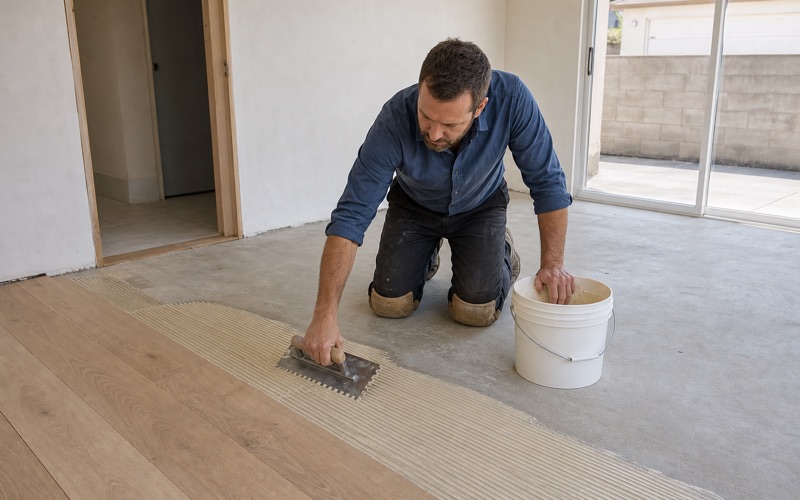
Installer spreading adhesive across a bare concrete slab with a notched trowel before laying engineered oak boards, several rows already bedded down.

Engineered Hardwood Flooring

Engineered hardwood supplied and installed over slab or subfloor in Bell Gardens, with wear layer thickness stated in millimeters on the quote.

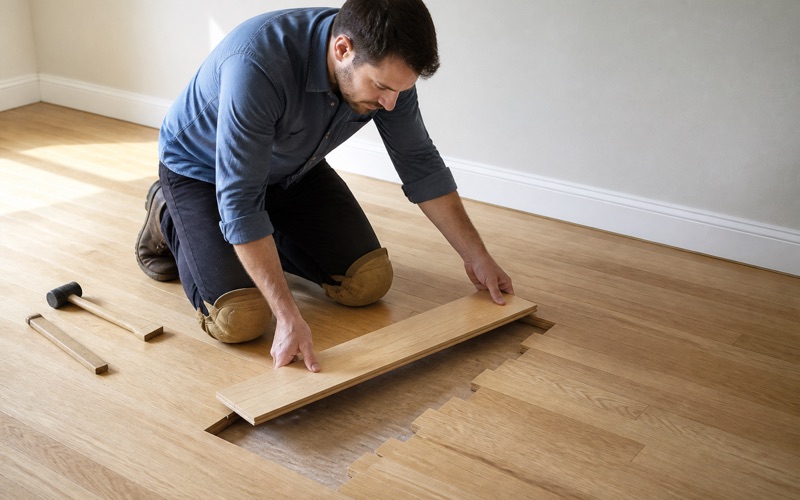
Installer lacing a replacement white oak board into an existing floor, the new board's end joint staggered against the surrounding rows.

Hardwood Floor Repair

Board replacement, weave-in repairs and squeak fixes for hardwood floors in Bell Gardens, kept as small as the damage genuinely is.

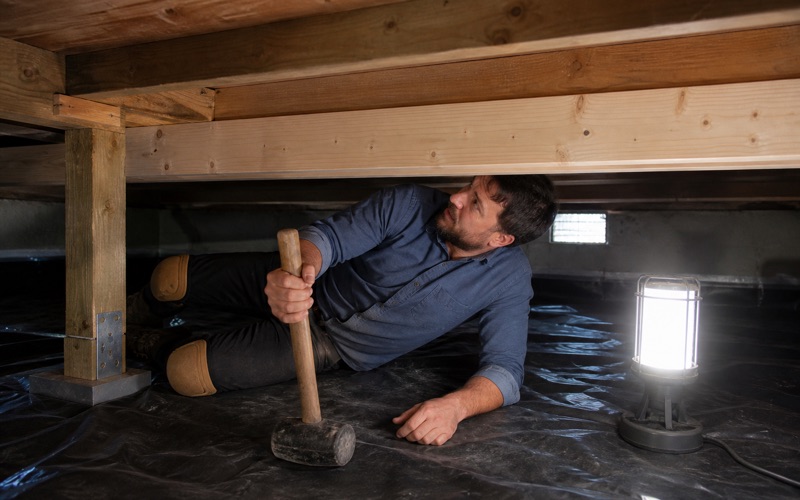
Carpenter fitting a sister joist alongside a sagging original in a crawl space, the new member bolted tight against the old with the subfloor boards overhead.

Subfloor and Moisture Repair

Slab testing, crawl space moisture control, joist and subfloor repair in Bell Gardens, priced as its own job rather than hidden in a floor rate.

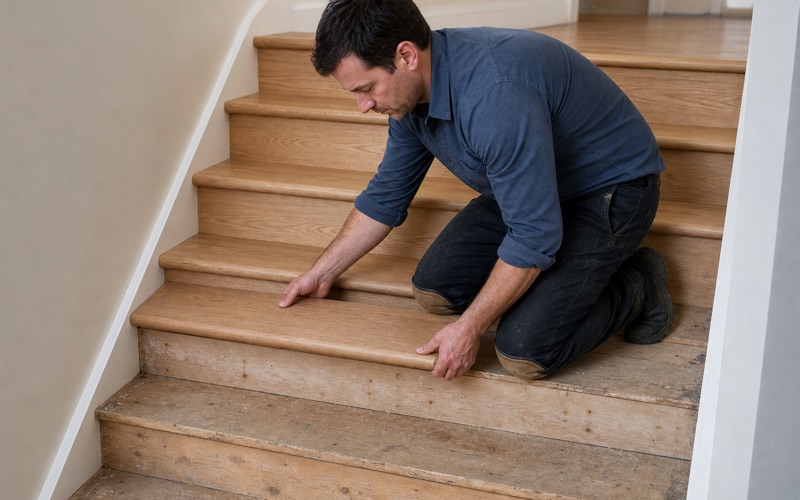
Joiner seating a white oak retro tread with a bullnose front edge onto a stair carriage, the nosing overhanging the riser below.

Hardwood Stairs

Stair treads, risers and nosings in hardwood for Bell Gardens homes, including carpet-to-wood conversions matched to your existing floor.

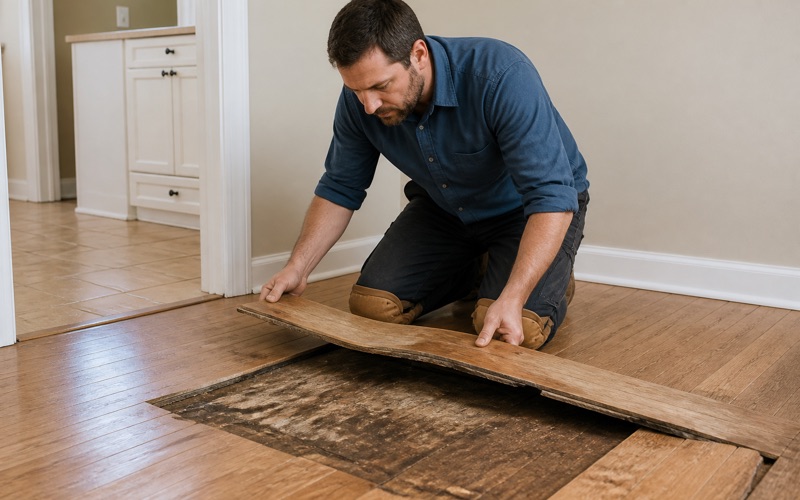
Worker lifting a delaminated white oak board clear of a water damaged floor, the sound boards and exposed subfloor visible beside it.

Water Damaged Hardwood Floor Repair

Drying, assessment and repair of water damaged wood floors in Bell Gardens, with readings taken over days rather than a verdict on day one.

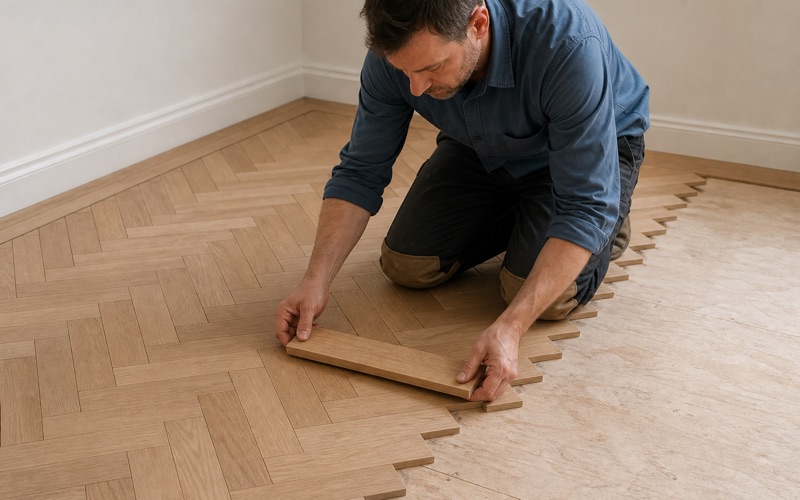
Installer setting a white oak herringbone block against its neighbor in a partly laid pattern floor, the field advancing from a center line.

Pattern and Wide Plank Flooring

Herringbone, chevron and wide plank floors in Bell Gardens, set out from a center line and laid on a substrate prepared for the pattern.

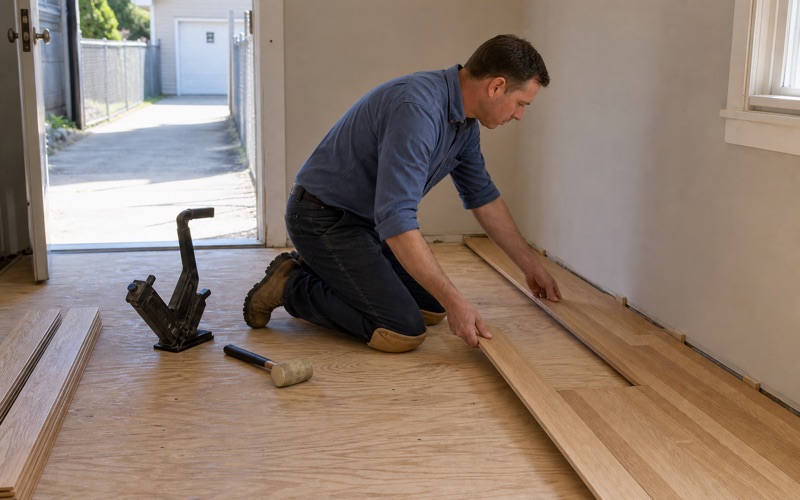
Installer lowering a solid white oak strip board against the last laid row over a plywood subfloor, the flooring nailer and mallet set down behind him.

Solid Hardwood Floor Installation

Solid nail-down hardwood installed over raised floors in Bell Gardens, the longest-lived floor available where the foundation allows it.

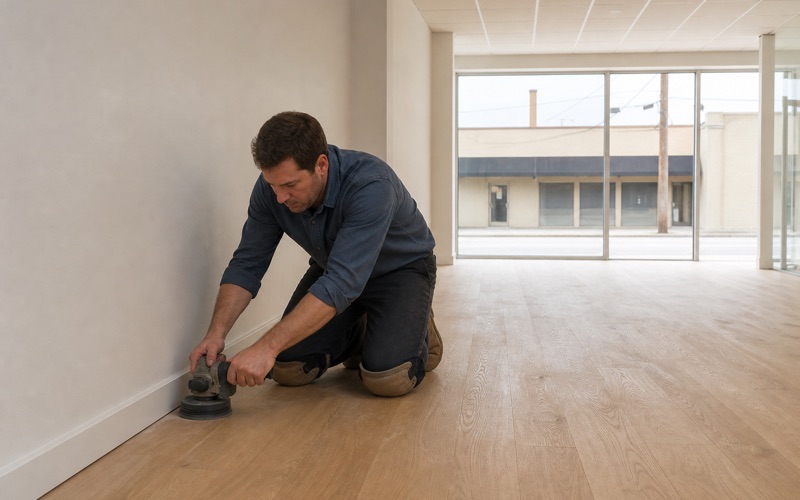
Operator running an edger along the base of an empty commercial unit with a white oak floor, the boards meeting a painted base in the corner.

Commercial Wood Flooring

Wood floors for offices, retail and hospitality in Bell Gardens, specified for commercial traffic and phased around your operating hours.

Two Decades of Wood Floors in One Corner of Los Angeles County

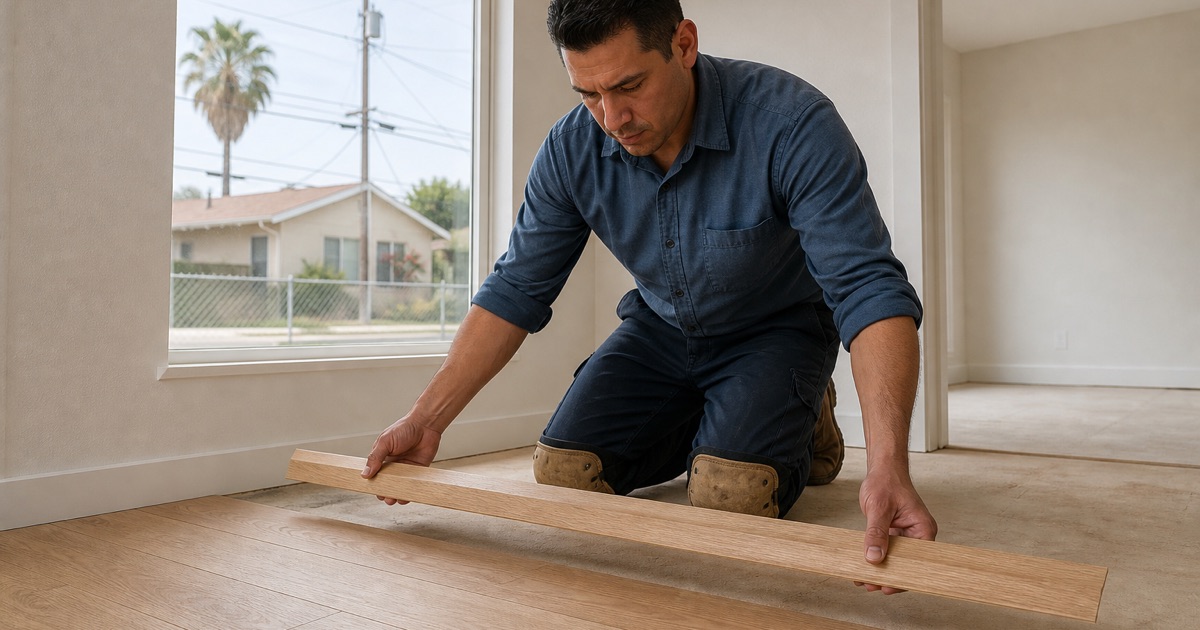
Installer lowering a white oak board into place beside the previous row in a Bell Gardens living room, the laid boards running under the shoe molding behind him.

More Than Twenty Years in the Trade

We have been laying and restoring wood floors for over twenty years, most of it within a few miles of here. Time in one small area is worth more than it sounds: we have opened up enough of these particular houses to know what is usually under the floor before we lift a board.

Licensed for the Work We Actually Do

Wood flooring in California sits under the C-15 Flooring and Floor Covering classification at 16 CCR 832.15, which expressly covers wood floors including the finishing and repairing of them. We work inside that classification and carry the bond the Contractors State License Board requires.

Why Choose Bell Gardens Wood Flooring

Foundation Settled Before Price

Every quote names the foundation type first, because Bell Gardens is split close to evenly between raised construction and slab, and that one fact decides whether solid wood is available to you at all. Guessing it is how a homeowner ends up with a product the house cannot take.

Slab Readings Written Down

No material gets ordered against a slab we have not tested. We take relative humidity with an in-situ probe placed to the ASTM F2170 method, record the number, and hold the job if it sits above the 75 percent threshold, so an installation fails on paper in week one rather than under your furniture in month six.

Coatings here are capped at 275 grams per liter for wood coatings under South Coast Air Quality Management District Rule 1113, and that rule reaches the contractor who stores or applies the product, not only the manufacturer who sells it. We specify from what is lawful to apply in this air basin instead of ordering a finish that a national supplier ships everywhere.

Lead-Safe on Pre-1978 Houses

About eighty percent of housing here went up before 1979, putting most of our work inside the federal Renovation, Repair and Painting rule. Sanding is precisely the disturbance it governs, so containment is our default on older houses rather than an upgrade sold after the machines are running.

Work Scheduled Inside City Hours

Bell Gardens prohibits construction work between 7 p.m. and 8 a.m. within 500 feet of a residential zone, and in a city this dense that radius covers effectively all of it. We schedule sanding and machine work to finish inside those hours, so a job never becomes your neighbors’ problem or a code complaint against the house.

Priced Per Unit, Not Per Lot

Most property in Bell Gardens is not one house on one lot. A typical parcel here carries two to four separate detached houses down its length, so we quote and schedule each unit on its own, rather than averaging a number across a lot and leaving an owner unable to tell which unit cost what.

Slab, Crawl Space and What Goes Underneath

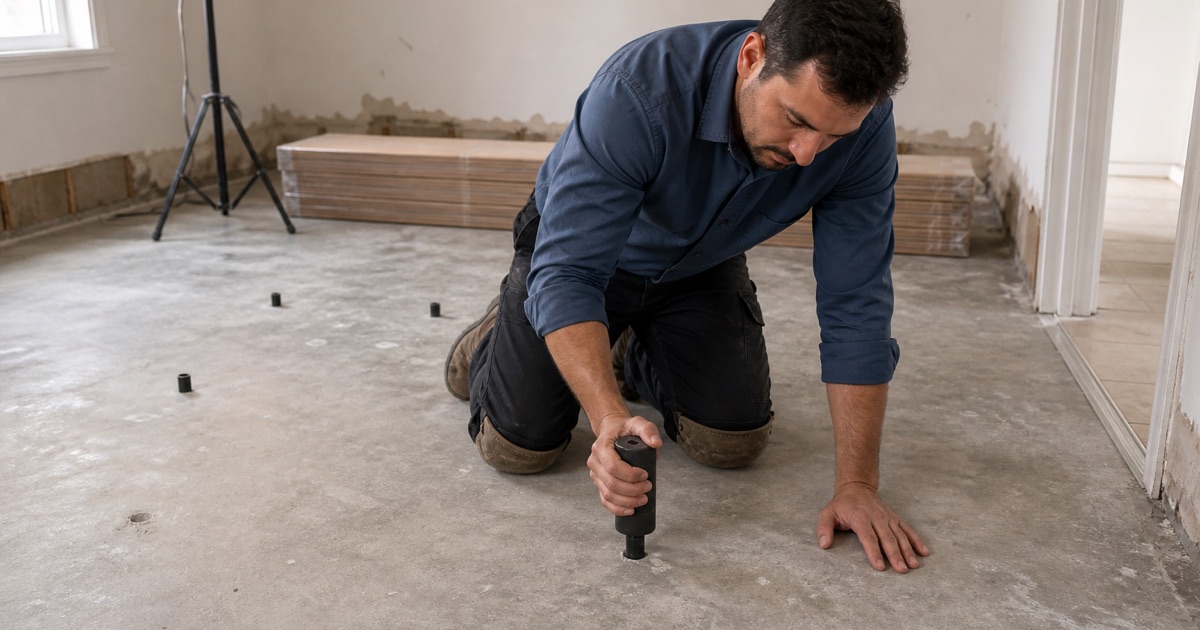
Technician seating a relative humidity probe sleeve into a drilled hole in a bare concrete slab, the meter body filling his palm with its display turned away.

Telling a Slab House From a Raised One

The quickest reliable check is height and access: a raised floor sits a step or more above grade and has vents or a crawl hatch somewhere along the perimeter, while a slab house meets the ground almost flush. We confirm it from below wherever there is access rather than from the doorstep, because an added room on a slab behind an original raised house is common here and changes the answer room by room.

What the Foundation Rules In and Out

Over a crawl space you can have solid nail-down, which is the longest-lived floor available and can be resanded for decades. Over slab that option largely disappears, and the real choice becomes glue-down or floating engineered. We tell you which list you are choosing from before you start looking at samples, so nobody falls for a floor the house cannot take.

Testing a Slab Before Any Wood Goes On It

Concrete releases moisture for far longer than most people expect, and a slab that looks bone dry can still be well above the limit. We use an in-situ relative humidity probe drilled to the ASTM F2170 method, and a calcium chloride test where that is the better fit, then hold the result against the 75 percent ceiling before a single box is ordered.

Vapor Retarders, and When They Are Not Enough

A vapor retarder over concrete slows moisture reaching the underside of the boards, and for glue-down engineered it is often the whole answer. It is not a license to put solid wood on a wet slab. Where readings stay high we say so and specify a system built for that condition rather than selling a membrane and hoping.

Crawl Space Ventilation and Ground Cover

Under a raised floor, bare soil feeds moisture straight into the joists and the back of the boards all year. We look for a ground cover of 6-mil polyethylene and for vents that are actually clear, because a cupping floor is very often a crawl space problem wearing a flooring problem’s clothes.

Joists and Subfloor Before Anything Finished

A finish floor is only as flat and as sound as the deck under it. We inspect joists for rot, sag and previous notching, check the board or plywood subfloor for movement, and price sistering or replacement as its own line, so the structural work is visible rather than buried in a square-foot rate.

Glue-Down Against Floating on a Slab

Glue-down puts the board in full contact with the slab and feels solid underfoot, but it demands a flatter slab and a clean, sound surface. Floating is more forgiving of a slab with a history and is faster to lift later. We match the method to what the slab actually measures rather than to whichever is quicker to install.

Squeaks That Come From Below

A squeak is usually the subfloor moving against a joist or a fastener, not the finish boards rubbing each other. Chasing it with surface fasteners hides it for a season. Where there is crawl access we fix it from underneath with blocking, shims and screws, which is the only version of that repair that lasts.

Houses From Before 1949

California began requiring foundation bolting in 1949, and a good share of this city predates that. An unbolted cripple wall can carry movement that shows up in the floor as recurring gaps or a soft spot that keeps coming back. We flag it when we see it, because that is a structural conversation rather than a flooring one.

Sanding, Recoating and Refinishing

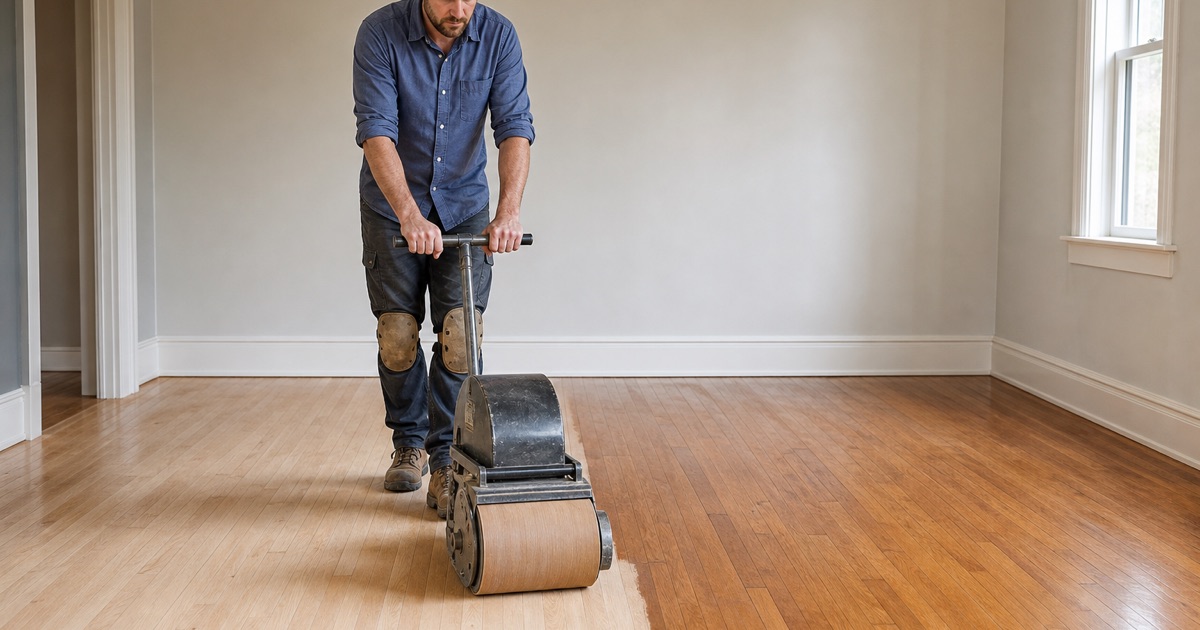
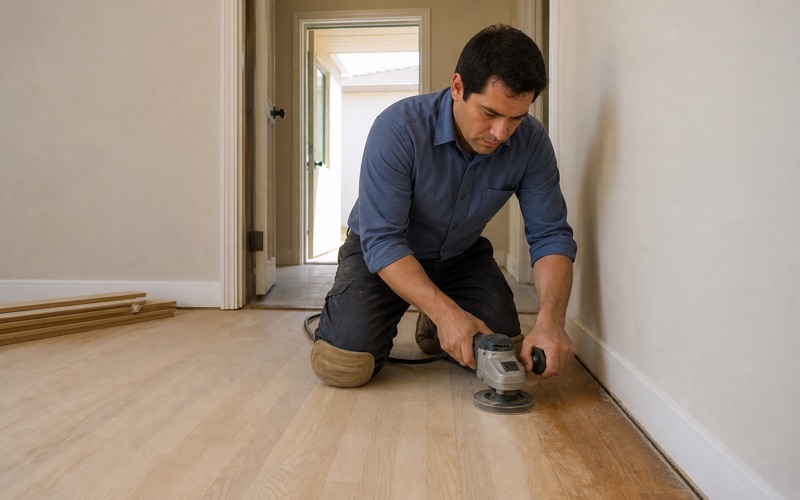
Floor sander working a room of red oak boards toward the doorway, both hands on the machine handle bar and the sanded field pale behind him.

Screen and Recoat Against a Full Refinish

If the finish is worn but the wear layer is intact and there are no stains into the wood, a screen and recoat abrades the existing surface and adds a fresh coat in a fraction of the time and cost. Once damage has reached the wood itself, only a full sand will do. We tell you which one your floor qualifies for.

How Many Refinishes a Floor Has Left

Solid wood can be sanded down to the top of the tongue, which on traditional strip flooring is several full refinishes across a very long life. We measure remaining thickness at a vent or a threshold rather than estimating from the surface, so you know whether this refinish is one of many or the last one available.

Refinishing Without Sanding

Chemical abrasion and recoat systems are real and they work within their limits, which are a sound existing finish and no damage into the wood. They are marketed well past those limits. We use them where they genuinely apply and say plainly when a floor is beyond what they can do, rather than selling a cheap pass that fails in a year.

Waterborne Against Oil-Modified Polyurethane

Waterborne finishes cure faster, stay clear, and keep the wood close to its natural color. Oil-modified builds a warmer amber tone that deepens over time and takes longer between coats. Both are available under the 275 gram per liter limit that applies here, so this is a question about appearance and schedule rather than about what is permitted.

What Dustless Sanding Does and Does Not Do

A dustless system captures the great majority of what the drum sander, edger and buffer produce, at the machine, before it reaches the air. It is not a sealed room. We pair it with containment at doorways and negative air where the house is occupied, because the honest version of dustless is very good extraction plus containment.

When the Floor Can Be Walked On

Cure and dry are different things. A waterborne floor is usually walkable in hours and takes days to reach full hardness, while an oil-modified floor is slower at both. We give you a written schedule with dates for socks, for furniture and for rugs, because rugs going down early is one of the most common ways a new finish is damaged.

Whether the Furniture Has to Leave

For a full sand, everything comes out of the room, including what is in the closets, because the machines need the whole floor. For a screen and recoat we can sometimes work in halves. We say which applies before the day, so nobody is moving a bedroom at 7 a.m. on a work morning.

Stain, Color and What the Species Will Take

Red oak takes stain evenly and is forgiving. Maple and some other close-grained species blotch unless they are conditioned first, and no amount of technique makes them behave like oak. We sample the actual stain on your actual floor in the room’s own light, because a chip from a display board is not a prediction.

Refinishing Engineered Wood

Engineered board can be refinished only if its wear layer is thick enough, and plenty of what is sold in this market is not. Sanding through the veneer into the core is unrecoverable. We measure the wear layer at a cut edge before agreeing to sand anything engineered, and recommend a recoat instead where the number is too thin.

When a Floor Cups, Buckles or Gets Wet

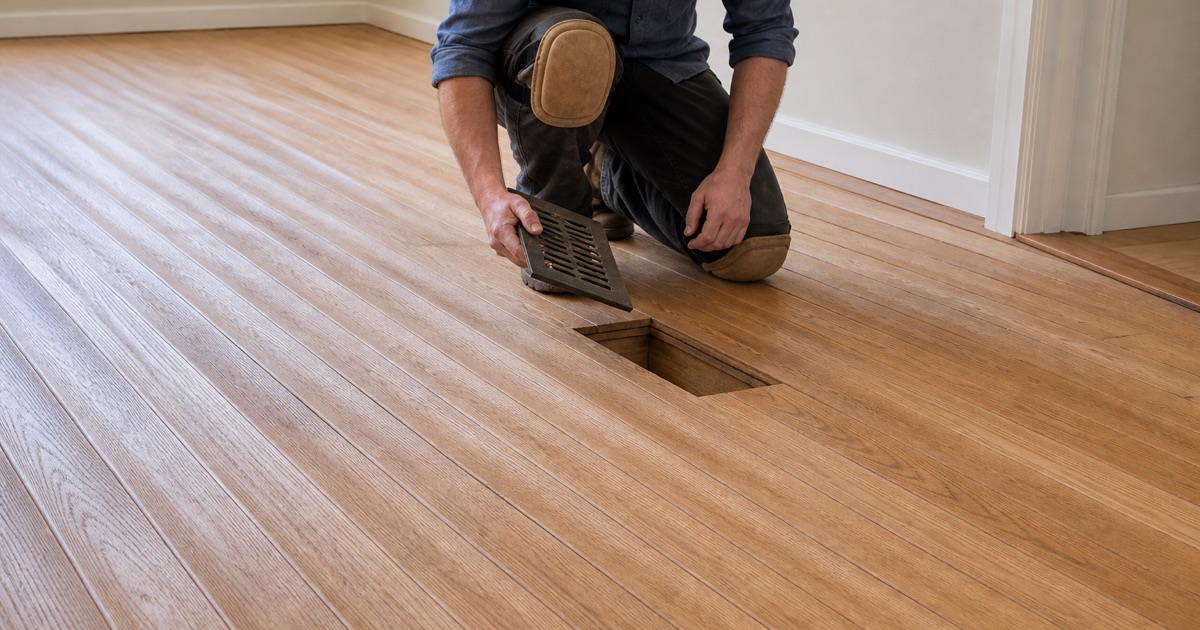
Worker lifting a floor register out of a cupped white oak floor, the board edges standing visibly proud of their centers across the whole room.

What Cupping Is Telling You

Cupping is board edges sitting higher than board centers, and it means the underside is wetter than the top. The floor is a symptom; the moisture is the problem. We find and fix the source, usually a crawl space, a slab, a leak or an appliance, before doing anything at all to the wood.

Cupping, Buckling and Crowning Apart

Cupping is edges high, crowning is centers high, and buckling is board lifting clear of the subfloor entirely. Crowning often means a cupped floor was sanded flat while it was still wet, which is a repair that created a second problem. Naming it correctly is what decides whether the fix is drying, sanding or replacement.

Whether a Cupped Floor Flattens on Its Own

Frequently it will, once the moisture source is gone and the floor has equalized over weeks or months. That is why we do not sand a cupped floor on the first visit. Sanding wet wood flat guarantees crowning later, and turns a floor that would have recovered into one that has to come up.

Drying in Place Against Replacing

Where water has been present briefly and the boards are still fastened and sound, controlled drying with monitored readings often saves the floor. Where boards have delaminated, buckled clear or sat wet for a long period, replacement is the honest answer. We take readings over several days rather than deciding on day one.

How Long Drying Takes

A wet wood floor takes weeks rather than days to return to a stable moisture content, and the subfloor underneath it is usually slower than the boards. We monitor with pin and pinless meters set for the species rather than working to a fixed number of drying days, because the floor is finished drying when the readings say so.

Gaps That Open and Close

Wood moves across its width with the seasons, so thin gaps appearing in the dry part of the year and closing later are normal on a solid floor. Gaps that keep widening, or that stay open all year, point at a moisture problem or at boards installed at the wrong moisture content. We measure before deciding which you have.

Pet Stains That Reached the Wood

Once urine has passed the finish and entered the wood, sanding usually will not remove it, because the discoloration goes deep and the odor is in the fibers. Board replacement is normally the real fix. We are straight about that rather than sanding a floor twice and charging for both.

Scratches, Dents and Single Bad Boards

Surface scratches in the finish can often be handled with a screen and recoat. Damage into the wood, or a single split or stained board, is a board replacement, woven in so the repair does not read as a patch. We keep the repair as small as the damage genuinely is.

Working Alongside an Insurance Claim

On a water-damaged floor we document the readings, the affected area and the scope in writing so it can be handed to an adjuster without translation. We work to what the floor needs and give you the evidence to support it. We are a flooring contractor rather than a public adjuster, and we do not advise on coverage.

Choosing Boards, Grades and Finishes

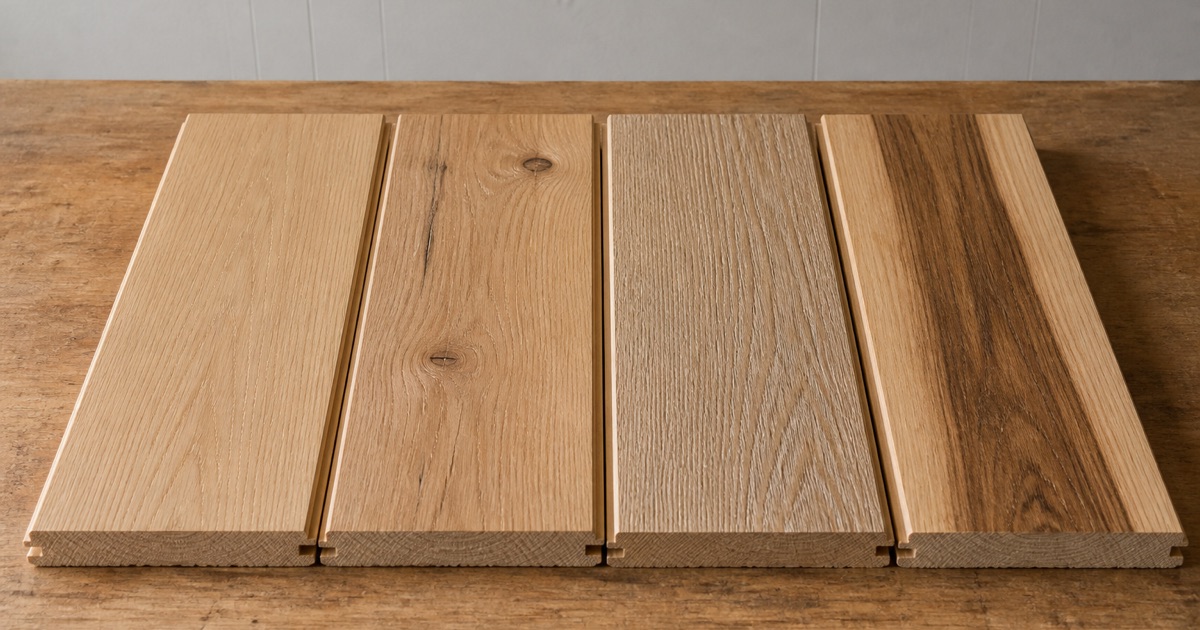
Four white oak and hickory board samples laid side by side on a workbench showing different grades, textures and sheen levels.

Solid Against Engineered

Solid wood is one piece through its thickness, can be sanded many times, and needs a raised floor or a plywood subfloor to fasten into. Engineered is a real wood wear layer over a stable core and can go over concrete. In this city the foundation usually makes this decision for you, which is why we settle it first.

Wear Layer Thickness

The wear layer is the only part of an engineered board that can ever be sanded, and it ranges from a veneer that can never be refinished to several millimeters that behaves much like solid. It is the number that decides whether your floor has a second life in fifteen years. We put it in the quote in millimeters.

White Oak, Red Oak and Hickory

The Janka scale measures resistance to denting: white oak comes in around 1360 and hickory around 1820, which is meaningfully harder. Hardness is not the whole story, since grain and finish hide wear as much as density does. We match species to the traffic the room actually gets rather than selling the hardest option by default.

Mill Grades and Character

Grade describes appearance rather than strength. A clear grade is uniform and calm and costs the most; the character grades carry knots, mineral streak and color variation, and mill grading rules such as those long used by NOFMA are what make those categories mean anything between suppliers. We show you the actual grade in a full box, not a single sample board.

Wide Plank and What It Needs

Wide boards move more across their width than narrow strip does, so they demand a flatter subfloor, tighter moisture control and often both adhesive and fasteners. Installed without that they cup and gap far more visibly than strip. We specify the substrate work wide plank needs, or we recommend a narrower board.

Herringbone, Chevron and Patterns

Herringbone sets rectangular blocks at right angles; chevron cuts the ends on an angle so the points meet in a continuous V. Both are set out from a center line established across the room rather than from a wall, since walls in these houses are rarely square. Pattern work is unforgiving of a subfloor that is not flat.

Wire-Brushed, Hand-Scraped and Smooth

Wire-brushing scrubs out the softer early wood to leave the grain standing, which hides scratches well. Hand-scraped carries a rolling, worked surface. Smooth shows everything, both the wood and every mark on it. We steer texture by how the room is used and by who lives in it, not by what is currently fashionable.

Sheen and What It Reveals

Sheen is measured with a gloss meter and runs from matte through satin to semi-gloss. Higher sheen reflects more light and shows every scratch, footprint and dust film; matte hides traffic best but can look flat in a dark room. Satin is the usual compromise, and we show you the options on the floor rather than on a card.

Prefinished Against Site-Finished

Prefinished board arrives with a factory-cured finish, installs fast and has micro-bevels between boards that collect grit over time. Site-finished is sanded and coated in place, giving a continuous flat surface and exact color control, at the cost of days on site. We lay out both honestly against your schedule and your tolerance for disruption.

Areas We Serve

Bell Gardens Wood Flooring provides wood flooring throughout the greater Bell Gardens area, with the same crews and the same standards on every job. - Wood Flooring in Cudahy

Good to know

Frequently Asked Questions

How much does a wood floor cost in Bell Gardens?

It depends on the foundation, the state of the subfloor and the product, which is why we do not publish a square-foot rate. Refinishing a sound floor is the cheapest route because the floor already exists. A new floor over a slab needing testing or grinding costs more than the same floor over a sound crawl space. You get a written, itemized quote with subfloor work on its own line.

Do I need a permit to have a wood floor installed?

Floor covering is exempt finish work here. Bell Gardens builds on the Los Angeles County code, and Title 26 Section 106.3 lists finish work among the exempted items, with a disabled-access qualifier that matters on commercial jobs. The limit worth knowing is that the exemption covers the covering, not the structure: repairing joists or subfloor is altering the building, which the Residential Code treats as permit work at Section R105.1.

How long will the job take?

A screen and recoat is usually a day plus cure time. A full sand and refinish is typically several days including coats. A new installation depends far more on what is underneath than on the floor itself, and slab remediation or subfloor replacement can add a week. We give dates rather than ranges once we have seen the house, including when furniture can come back.

Are you licensed and insured?

Yes. Wood flooring falls under the C-15 Flooring and Floor Covering classification at 16 CCR 832.15, which covers installation, finishing, repair and surface preparation. We work within it, carry the bond the Contractors State License Board requires, and hold liability coverage. We also hold a Bell Gardens business license, which the city requires of any trade working here whether or not it keeps premises in the city.

Can I put solid hardwood over a concrete slab?

Usually not, and we will say so rather than take the job. Solid wood needs something to fasten into and moves too much to sit on concrete. Over slab the right products are glue-down or floating engineered, chosen against a measured humidity reading. Systems exist that build a fastenable surface over a slab, but they raise the floor height and only suit specific cases.

My floor has started to cup. Is it ruined?

Usually not, and the worst thing to do is sand it. Cupping means the underside of the boards is wetter than the top, so the first job is finding the source, often a crawl space, a slab, a leak or an appliance. Once corrected, many floors flatten out over weeks or months. Sanding while the floor is still wet causes crowning, which is the harder problem.

Will there be dust everywhere?

Far less than a floor sanded without extraction, but nobody should promise none. Our machines run on a containment system that captures the great majority of what they produce at the source, and we seal doorways and use negative air in an occupied house. On pre-1978 houses, which is most of this city, containment is not optional for us anyway under the federal lead-safe rule.

Do you work on rental properties and multi-unit lots?

Regularly, and it is what most of the housing stock here looks like. A typical Bell Gardens lot carries two to four separate detached houses, so we quote and schedule per unit rather than averaging across a parcel. For turnovers we work to the date the unit has to be back in service, and we will say when a recoat is sensible and when the floor needs more.

What finishes can you legally use here?

Wood floor coatings in this air basin are capped at 275 grams per liter of volatile organic compounds under South Coast Air Quality Management District Rule 1113, and that rule reaches the contractor applying and storing the product. Plenty of professional waterborne and oil-modified systems sit inside that limit, so it constrains the catalog rather than the quality.

Can you match an existing floor for a repair?

Often, and it is worth trying before replacing a whole room. Matching means species, grade, width, thickness and profile, and on older floors the profile is usually the hard part because milling has changed. Where we can source a match we weave new boards into the existing field so the repair does not read as a patch. Where we cannot, we say so.

Ready to Get Started?

Request a free quote today and we'll get back to you fast.