
Bell Gardens Wood Flooring builds and refinishes hardwood stairs in Bell Gardens, CA and across the nearby cities, including Downey, Norwalk, Montebello, Pico Rivera and Whittier. Stairs are the part of a wood flooring job that most general flooring companies quietly avoid, and it shows in what is available locally.
There is a reason for the avoidance. A staircase is joinery rather than flooring: every tread is cut to its own opening, nothing in an older house is square, and the finished result is at eye level on approach rather than underfoot. It takes longer per square foot than any other part of a floor by a wide margin.
It is also the most visible woodwork in most houses, and the piece that dates an interior fastest. A carpeted staircase in a house with wood floors throughout is the single most common thing we are asked to change, and converting one properly is a genuinely transformative job.
Carpet to Wood Conversions
What Is Under the Carpet
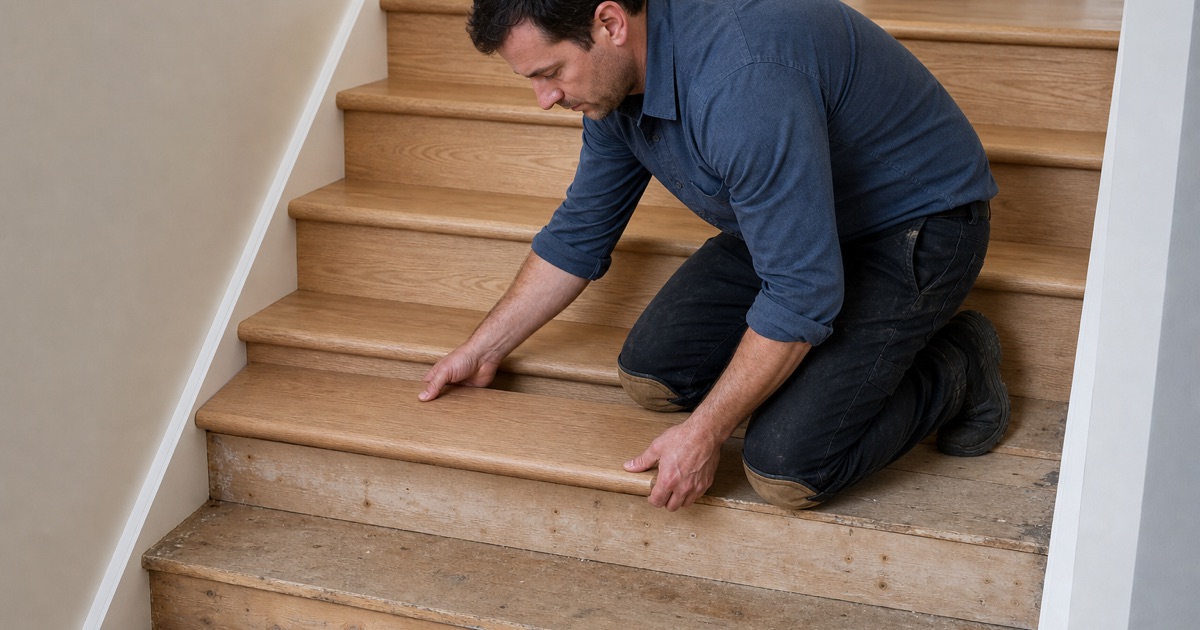
Lifting carpet off a staircase reveals one of two things. Some stairs were built as finished woodwork and carpeted later, in which case the treads may only need repair and refinishing. Most were built as rough carriage stock never intended to be seen, and those need new treads and risers over the existing structure. We check before quoting, because the two jobs cost very differently.
Retreading Over Existing Structure
Where the stringers and carriage are sound, new hardwood treads and risers are fitted over them. This keeps the staircase geometry exactly as it is, which matters because rise and run are set by code and altering them turns a finish job into a construction one. Each tread is scribed to its own opening rather than cut to a single measurement.
Nosings, Returns and the Details That Show
The nosing is the front edge of the tread, and on an open-sided staircase the returned end is the detail people actually look at. A mitered return with the grain carried around reads as built joinery; a square-cut end reads as a retrofit. These details are most of the difference between a staircase that looks original and one that looks added.
Matching Stairs to Your Floor
Species, Grade and Color
Stairs sitting in the middle of a wood floor have to match it, and stair stock is milled differently from flooring stock. We match species and grade to the floor, and where the floor is being refinished at the same time we finish both together so the color is genuinely identical rather than approximately so.
Landings and Transitions
Landings are laid as floor rather than as tread, so the transition between the two has to be resolved deliberately. Where a landing meets an upstairs floor, the nosing detail carries across and the board direction is chosen so the landing reads as part of the staircase rather than as an offcut of the hallway.
Engineered Stair Parts
Where the floor is engineered, matching stair components in the same product line keep the look continuous. Solid stair treads can also be finished to match an engineered floor closely. We will tell you which route matches better for your specific product, since some manufacturers’ stair parts are a genuine match and some are not.
Refinishing an Existing Staircase
Sanding Treads and Risers
An existing hardwood staircase can be refinished like any other wood, but it is hand and detail work rather than machine work, because a drum sander cannot reach a tread and an edger will damage a riser. It is slower per square foot than a floor and the finish quality is judged more closely, because it is seen at eye level.
Repairing Loose or Split Treads
A tread that flexes or creaks is usually loose at its housing in the stringer or has lost the wedges that hold it. The correct fix is from below where the underside is accessible, or by refixing and re-wedging from above where it is not. A split tread is replaced rather than filled, because a stair tread is structural.
Finish and Slip Resistance
A staircase is the one place in a house where finish sheen is a safety matter as much as a visual one. Higher gloss on a stair reads as slippery and shows every mark. We generally specify a satin or matte finish on treads for that reason, and there are finish systems with additives that raise slip resistance where that is a particular concern.
Handrails, Balusters and What We Do Not Touch
Working Around an Existing Balustrade
Most tread replacements are done with the existing handrail and balusters in place, cutting and fitting around the newel posts and baluster feet. It is slower than working on an open flight and it avoids disturbing a balustrade that is doing a safety job. Where balusters are housed into the treads themselves, we say so early because it changes the method.
Open Sides and Returned Treads
A staircase open on one side needs a returned nosing along that edge, mitered so the grain runs continuously around the corner. It is the detail that separates joinery from a retrofit, and it is also the one most often skipped. We price it in rather than presenting it as an upgrade.
Where We Bring In Another Trade
Structural changes to a staircase, altering a handrail height, or anything touching guard requirements is not flooring work and we do not present it as such. We will say plainly when what you want needs a general contractor, and we would rather hand that part over than take on work outside what our classification covers.
Practical Matters
Access While the Work Runs
A staircase is often the only route between floors, which makes it the one job that cannot simply be closed off for three days. We work in a way that keeps the stairs usable overnight wherever it is possible, usually by treating alternate treads, and we tell you in advance which nights that will not be possible.
How Long It Takes
A straight flight of a dozen treads converted from carpet is usually several days including finishing and cure time, and a staircase with winders, a turn or an open side takes longer because every one of those pieces is cut individually. We give dates once we have seen the actual staircase rather than quoting from a tread count.
Where a Stair Job Needs More Than Finish Work
Replacing treads and risers over sound existing structure is finish work. Altering the rise, the run, the stringers or a handrail is not, and that becomes a construction job with a different permit position. We are clear at the quote about which one you are asking for, because the two are frequently confused.
- Licensed & Insured
- 20+ Years Experience
- Free Written Quotes