
Bell Gardens Wood Flooring repairs water damaged hardwood floors in Bell Gardens, CA and the cities around it, including Bell, Cudahy, Maywood, South Gate and Commerce. It is the job where the fastest answer and the right answer are furthest apart, and where an early decision costs the most.
The pressure on a wet floor is to decide immediately, usually to tear it out. Sometimes that is correct. Frequently it is not: a floor that has been wet briefly and is still fastened down will often return to a stable moisture content over a few weeks and refinish perfectly well. Deciding on day one throws away floors that would have recovered.
So we take readings over several days before committing to a scope. That is slower, it is occasionally frustrating when someone wants a number that morning, and it is the only method that distinguishes a floor that is drying from a floor that is failing.
Assessing What Happened
Finding and Stopping the Source
Nothing useful happens while water is still arriving. Supply leaks, waste leaks, appliance failures, roof and window leaks and slab moisture all present as a wet floor and need different trades to correct. We identify where it is coming from first, and we will not schedule floor work over a source that is still active.
Mapping the Affected Area
Water travels along the floor’s own structure, so the wet area is almost always larger than the visible damage. We map it with a moisture meter across the field, checking well beyond the boards that look affected, because a scope drawn around the visible mark misses the part that fails three months later.
Reading the Subfloor as Well as the Boards
The finish boards dry faster than what is underneath them. A floor can read acceptably at the surface while the plywood or board subfloor below is still holding water, and laying a new floor on that reproduces the damage. We take readings at both levels and treat the slower one as the real number.
Drying Rather Than Demolishing
Controlled Drying in Place
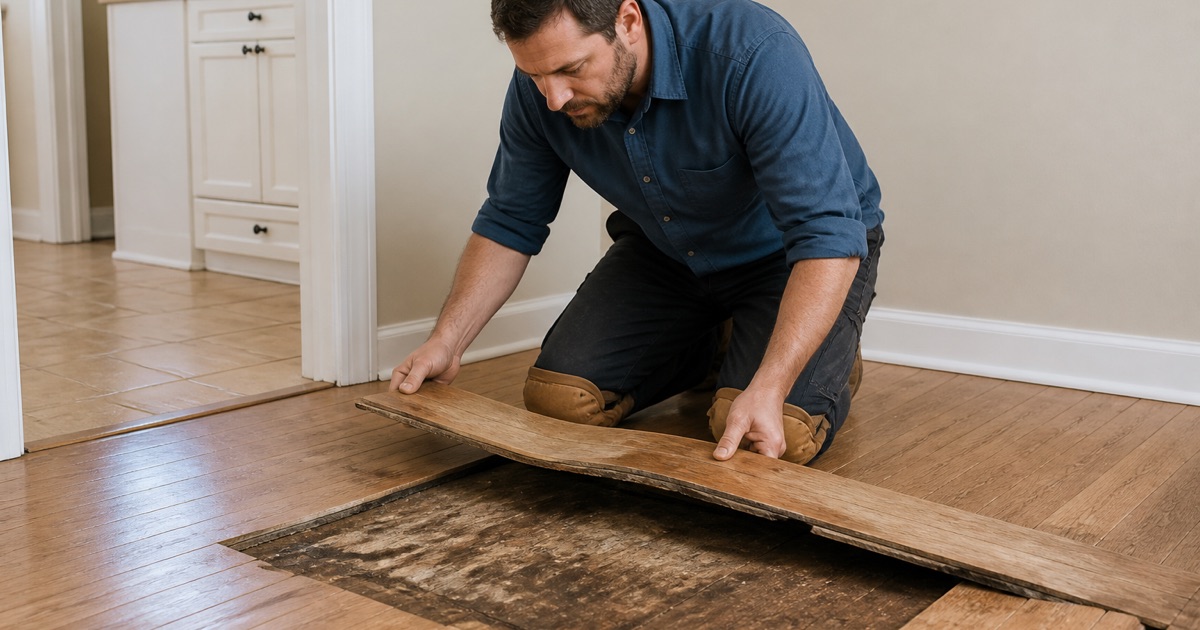
Where boards are still fastened, have not delaminated and have not buckled clear, controlled drying with air movement and dehumidification often saves the floor. It takes weeks rather than days, and it needs monitoring rather than a timer. The wood is dry when the readings say so and not when a schedule says so.
Cupping That Resolves Itself
Cupping is the underside of the boards being wetter than the top, and once the moisture source is gone many cupped floors flatten out on their own as they equalize. That is the single strongest argument for patience. Sanding a cupped floor before it has dried produces a crowned floor, which is a worse problem on less remaining wood.
When the Floor Genuinely Has to Come Up
Boards that have buckled clear of the subfloor, engineered board that has delaminated, and floors that sat wet long enough for the subfloor to fail are past saving. Long-standing contamination is also a replacement question rather than a drying one. We say so directly when we get there, with the readings that support it.
Putting the Floor Back
Partial Replacement and Weaving In
Where the damage is localized, the affected boards come out and matching boards are woven into the existing field with staggered joints so no seam shows. This keeps most of the original floor and costs a fraction of a full replacement, and on older stock the original boards are often better material than the replacement.
Subfloor and Structure First
If water reached the subfloor or the joists, that gets replaced or repaired before any finish floor goes back. Subfloor replacement runs to the joists rather than patching between them. This is structural work with its own permit position, and we quote it as its own line rather than folding it into a floor price.
Refinishing After Equalization
Once the floor has returned to a stable moisture content and any board replacement is done, the whole room is sanded and refinished together so the repair disappears. Refinishing before equalization is the most common way a recovered floor is ruined, and the wait is measured in weeks.
Where the Water Came From
Slab Moisture Mistaken for a Leak
On a slab house, a floor cupping across a whole room with no plumbing nearby is frequently not a leak at all but moisture coming up through the concrete. The fix is a moisture system under a new floor rather than a plumber, and testing the slab is what tells the two apart before anyone opens a wall.
Crawl Space Moisture Under a Raised Floor
Under a raised house, bare soil and blocked vents produce a slow, even cupping across large areas that looks like a flood and is not. A ground cover of 6-mil polyethylene and clear ventilation frequently corrects it. This is one of the cheapest fixes in the trade and one of the most commonly missed.
Appliance and Supply Line Failures
Dishwashers, refrigerator ice lines, washing machines and water heaters cause a large share of what we see, and they leak slowly for a long time before anything is visible at the surface. By the time the floor shows it, the subfloor beneath has usually been wet for months, so we check well beyond the visible mark.
Long-Standing Leaks and Structure
Where water has been present for a long period, joist ends at bearing points and the subfloor are the real concern rather than the finish boards. We inspect from below where crawl access exists. Structural repair is a different job with a different permit position, and we quote it as its own line.
Records, Insurance and Being Straight With You
Documentation You Can Hand Over
We record readings with dates and locations, photograph the affected area, and write the scope down. If you are making a claim, that is the material an adjuster needs and it is far more useful than a verbal account weeks later. We provide it as a matter of course rather than on request.
What We Are and Are Not
We are a flooring contractor. We assess and repair floors, and we document what we find. We do not advise on whether your policy covers a loss, we do not act as a public adjuster, and we do not tell you what your insurer is obliged to do. Those are questions for your carrier or for someone licensed to advise on them.
No Pressure to Decide Immediately
A wet floor feels like an emergency and the drying part genuinely is urgent, but the decision about the floor’s future is not. We will get air moving and readings started quickly, then give you the information as it develops. Anyone who tells you on the first visit that the whole floor must go has not measured it yet.
- Licensed & Insured
- 20+ Years Experience
- Free Written Quotes