
Bell Gardens Wood Flooring lays pattern and wide plank floors across Bell Gardens, CA and the surrounding cities including Montebello, Alhambra, San Marino and Whittier. These are the floors where the substrate work matters most and where a contractor’s willingness to prepare properly shows up soonest.
Pattern floors and wide boards are less forgiving than strip flooring in every respect. A herringbone set out from a wall instead of a center line runs visibly crooked by the far side of the room. A wide board over a subfloor that is not flat cups and gaps far more obviously than a narrow one, because it has more width across which to move.
None of that is a reason to avoid them. It is a reason to price the preparation honestly and to say no to a job where the substrate cannot be made right, rather than laying a beautiful floor onto a surface that will spoil it within a year.
Pattern Floors
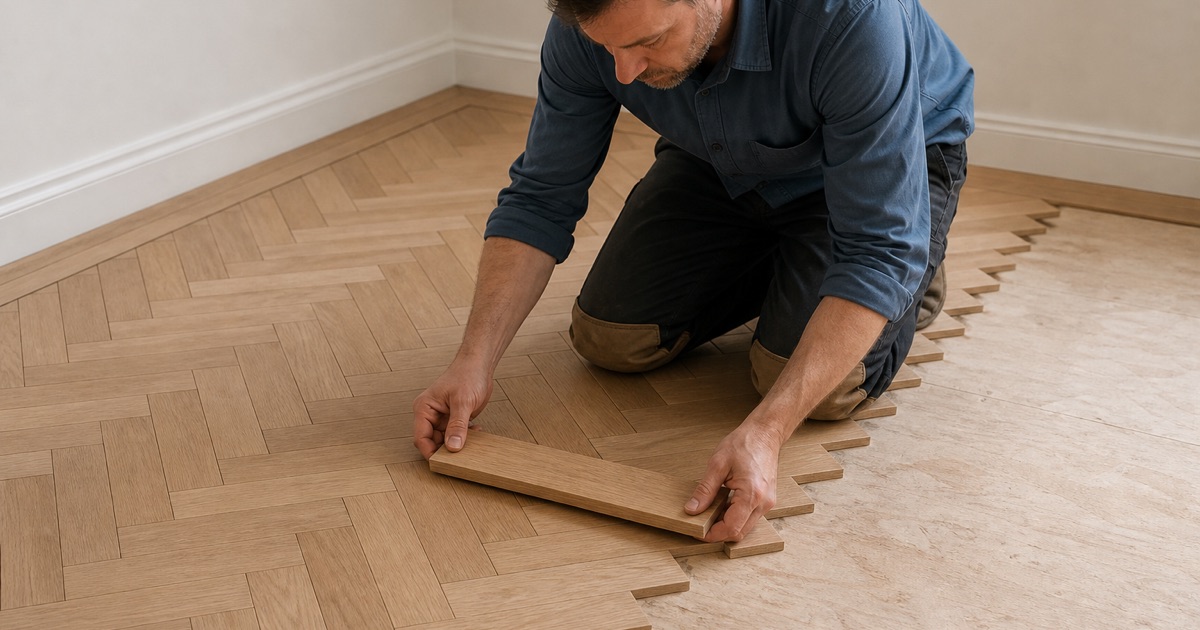
Herringbone
Herringbone sets rectangular blocks at right angles to one another in a zigzag, with each block’s end meeting the next block’s side. It is the most recognizable pattern floor and the most forgiving of the pattern layouts, because the individual pieces are small and the geometry absorbs minor variation better than chevron does.
Chevron
Chevron looks similar at a glance and is a different product entirely. The board ends are cut at an angle so that the points meet in a continuous V running down the room. The angled cuts mean the boards are milled specifically for it and cannot be improvised from standard stock, and any error in the set-out is visible along the whole run.
Borders, Feature Strips and Parquet
A border framing a room, a feature strip marking a threshold, or a true parquet panel are all traditional work that suits older houses well. They take considerably longer to lay than a running floor and they are the details that make a floor look designed rather than delivered.
Wide Plank
Why Width Changes the Engineering
Wood moves across its width rather than its length, so a seven inch board moves roughly twice as much as a three inch one under the same change in moisture. That is why wide plank demands tighter moisture control, a flatter substrate and frequently both adhesive and mechanical fastening, where narrow strip would be fine nailed alone.
Engineered Wide Plank
Wide boards in engineered construction move far less than solid ones of the same width, which is why most wide plank sold today is engineered. Over a slab it is the only sensible route to a wide board. The wear layer question matters as much here as anywhere, and we state it in millimeters.
Character Grades and Long Boards
Wide plank is usually specified in a character grade, where knots, mineral streak and color variation are the point rather than a defect. Longer average board length is part of what makes a wide floor look right, and it is one of the things that separates grades at very different prices.
Living With a Pattern or Wide Floor
Where a Pattern Suits the Room
Pattern floors read best in rooms with a clear geometry, entrances, and spaces seen from a doorway rather than long irregular runs. In a small or heavily broken-up room a pattern spends most of its effect on cut pieces at the perimeter. We will say where it will and will not repay the cost.
Repairs on a Pattern Floor
Individual blocks in a herringbone floor can be lifted and replaced, which makes it more repairable than people assume. Chevron is harder because the angled ends are milled to a specific product. Keeping a small quantity of the original material at the end of the job is worth doing, and we set it aside as a matter of course.
Movement in a Wide Board
A wide floor will show more seasonal movement than strip flooring, and some of that is normal rather than a defect. What matters is that it moves within a range, which comes from acclimation and moisture control at installation. We explain what normal looks like for your specific floor so it is not alarming when it happens.
Getting the Substrate Right
Flatness Before Anything
Pattern work and wide boards both fail at the joints when the surface under them is not flat. We measure across the room with a straightedge, and price grinding, patching or self-leveling compound openly as its own item. A floor laid over a wave telegraphs it permanently.
Setting Out From the Room
Walls in houses of this era are rarely square or parallel, so a pattern is set out from a center line established across the room rather than from any wall. Getting that line wrong is not recoverable once the floor is down, so it is checked and re-checked before adhesive goes anywhere near the substrate.
Moisture Control for Wide Boards
Wide boards need to arrive at the right moisture content and be acclimated in the room they will live in, with readings logged rather than assumed. A wide floor laid at the wrong moisture content will either gap dramatically in its first dry season or cup in its first wet one, and neither is fixable by refinishing.
- Licensed & Insured
- 20+ Years Experience
- Free Written Quotes