
Bell Gardens Wood Flooring handles subfloor and moisture repair across Bell Gardens, CA and the surrounding cities, including South Gate, Cudahy, Huntington Park, Bell and Maywood. This is the work that decides whether a wood floor succeeds, and it is the work most often left out of a quote until the floor is already open.
Bell Gardens sits on an unusual line. The city was built out mainly in the 1940s and 1950s, right where Los Angeles County stopped framing houses over crawl spaces and started pouring slabs, so roughly a third of the housing stock predates 1950 and about half predates 1960. Both foundation types are common here, sometimes on the same block, and each fails in its own way.
We treat what is under the floor as a job in its own right, with its own inspection, its own readings and its own line on the quote. That is partly honesty about price and partly because the two halves have different permit positions: floor covering is exempt finish work, and structural repair underneath it is not.
Finding Out What You Have
Slab or Raised, Confirmed Not Assumed
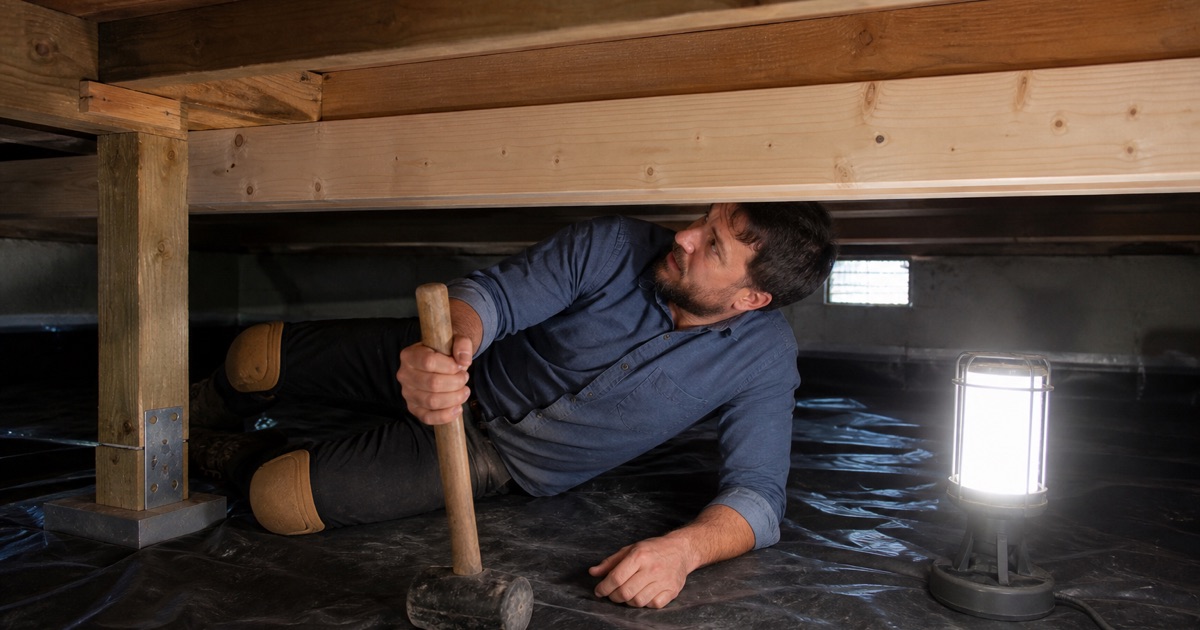
A raised floor sits a step above grade and has perimeter vents or a crawl hatch; a slab house meets the ground almost flush. We confirm from below wherever access exists rather than from the doorstep, because an addition built on slab behind an original raised house is common here and the answer changes room to room.
Reading the Floor for Symptoms
Cupped boards, a musty smell at floor level, a soft or springy patch, or gaps that never close through the year all point downward rather than at the finish. We map where the symptoms are before opening anything, because the pattern usually identifies the source faster than a random inspection hole does.
Moisture Readings Before a Scope
We take wood moisture content with pin and pinless meters set to the actual species, and slab readings where there is concrete. Readings come before a scope, not after, because a number taken on one visit is a snapshot and the useful information is often how it changes across several days.
Slab Work
In-Situ Relative Humidity Testing
The standard test for a concrete slab is an in-situ relative humidity probe placed into the slab to the ASTM F2170 method and left to equilibrate. Surface tests read the surface, which is not where the moisture is. We hold results against the 75 percent ceiling most manufacturers set, and record the number so the warranty position is documented.
Vapor Retarders and Moisture Systems
Where a slab reads high, a vapor retarder or a liquid-applied moisture mitigation system sits between the concrete and the floor. These are real solutions with real limits, and they are specified against a measured number rather than applied as insurance. A membrane does not make a wet slab suitable for solid wood.
Grinding and Flatness
Floating floors fail at the joints when the slab underneath is not flat, and glue-down needs full contact to bond. We measure across the room with a straightedge and price grinding, patching or self-leveling compound as a separate item, because it is a substantial cost that should never be hidden inside a square-foot rate.
Crawl Space and Raised Floors
Ground Cover and Ventilation
Bare soil under a raised house releases moisture into the joists and the underside of the boards continuously. A ground cover of 6-mil polyethylene laid properly and vents that are actually clear will fix a surprising number of cupping problems on their own, at a fraction of what refinishing the floor would cost.
Joists, Sistering and Rot
Where a joist has rotted at a bearing point or sagged, the fix is sistering a new member alongside it or replacing the section outright. We look for the cause as well as the damage, since a rotted joist end usually means water is arriving from somewhere that will still be arriving afterward.
Subfloor Replacement
Board subfloor that has cupped, plywood that has delaminated, or sheeting that moves underfoot has to be replaced before any finish floor goes down. We replace in full sheets or full boards to the joists rather than patching between them, because a patch supported on nothing is where the next soft spot appears.
Fixing Squeaks From Below
With crawl access, squeaks are corrected from underneath with blocking, shims and screws into the subfloor, leaving nothing visible on the finished side. Bell Gardens has enough raised construction that this route is available far more often than homeowners expect, and it is both cheaper and more permanent than face-screwing from above.
What Goes Wrong When This Is Skipped
A New Floor Over an Old Problem
The most expensive failure in this trade is a correctly installed floor over a substrate nobody tested. It looks perfect for a season, then cups, and the cost of putting it right is the whole floor plus the subfloor work that should have happened first. The saving on the front end is always smaller than the repair.
Sanding a Floor That Is Still Wet
A cupped floor sanded flat while it is still carrying moisture becomes a crowned floor once it dries, because the edges that were high are now low. That is not a refinishing error that can be sanded out later; on a floor with limited thickness left it can end the floor’s life.
Patching Between Joists
Cutting out a soft patch of subfloor and dropping a piece in that lands on nothing at its edges produces a new soft spot within a year. Replacement runs to the joists so every edge is supported. It is more material and more labor, and it is the only version that does not come back.
Permits, Records and Sequence
Where the Permit Line Sits
Bell Gardens builds on the Los Angeles County code, and Title 26 Section 106.3 lists finish work such as flooring among the items exempted from permit. Structural work is a different matter: the Residential Code treats altering or repairing a building as permit work at Section R105.1, and replacing joists or subfloor is exactly that.
Written Readings You Keep
Every moisture reading we take goes on paper with the date and the location it came from. That record is what supports a manufacturer warranty claim later, and it is what tells the next contractor what the slab was doing before the floor went down. Verbal assurances are worth nothing at that point.
Doing It in the Right Order
Moisture source first, then structure, then equalization, then the finish floor. Compressing that sequence to save a week is the single most common reason a new floor fails within its first year. We will hold a job rather than lay boards over a problem that is still active, and we say so at the quote rather than on the morning.
- Licensed & Insured
- 20+ Years Experience
- Free Written Quotes