
Bell Gardens Wood Flooring has been doing wood floor refinishing in Bell Gardens, CA for more than twenty years, serving surrounding cities including Cudahy, Bell, Commerce, Downey and Maywood. Refinishing is the largest part of what we do, because in a city where roughly half the housing stock predates 1960 there is a great deal of original wood still down and worth saving.
The first question on any refinishing job is not what finish you want. It is how much wood is left to work with. Solid strip flooring can be sanded down to the top of the tongue, which usually means several full refinishes across a very long life, but every previous pass has spent some of that. We measure what remains at a floor vent or a threshold before quoting, rather than estimating from the surface.
The second question is whether you need a full sand at all. A great many floors we look at need a screen and recoat, which costs a fraction of the price and takes a fraction of the time. We would rather sell you the smaller job and be the people you call in eight years than take the whole floor down because it was the larger invoice.
What Your Floor Actually Needs
Screen and Recoat
If the existing finish is worn but intact, and nothing has stained or damaged the wood itself, we abrade the surface with a buffer and screen and lay a fresh coat over it. The wood is never touched. It is a one-day job on most rooms and it resets the clock on a floor without spending any of its remaining thickness.
Full Sand and Refinish
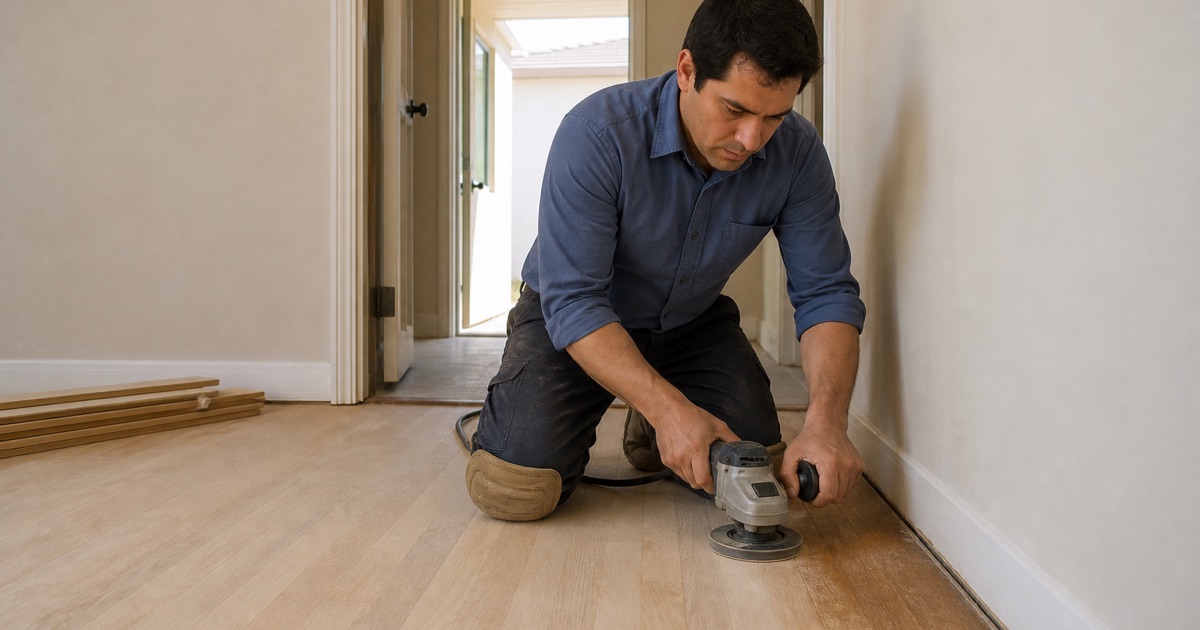
Once damage has gone through the finish and into the wood, only a full sand will remove it. We take the floor down through a grit sequence, typically 36 then 50 then 80, so each pass removes the scratch pattern the last one left. Skipping grits is the most common reason a floor looks fine until the finish goes on and every mark reappears.
When Neither Is the Answer
Some floors are past refinishing, and we will tell you. A solid floor already sanded to the tongue has nothing left to remove. Engineered board with a thin wear layer cannot be sanded at all without going into the core. In both cases a recoat may still buy years, and replacement is the honest recommendation when it will not.
Finishes and What They Do
Waterborne Polyurethane
Waterborne finishes go on clear and stay clear, so white oak keeps its natural color rather than ambering over. They cure fast, which means fewer days between coats and an earlier date for furniture. Modern waterborne systems are as hard-wearing as anything on the market, and they sit comfortably inside the coating limits that apply here.
Oil-Modified Polyurethane
Oil-modified builds a warm amber tone that deepens with age, which is what many people picture when they picture a hardwood floor. It takes longer to dry between coats and carries more odor while it does. On a red oak floor in an older house it often looks more at home than a water-clear finish does.
Hardwax Oil and Low-Sheen Systems
Hardwax oil penetrates rather than forming a thick surface film, which makes it repairable in patches instead of wall to wall. It wants more maintenance than a polyurethane and rewards it. Sheen runs from matte through satin to semi-gloss, and the lower the sheen the less every scratch and footprint will show.
Working Legally and Cleanly in This City
The 275 Gram Coating Limit
Wood floor coatings applied here are limited to 275 grams per liter of volatile organic compounds under South Coast Air Quality Management District Rule 1113, and that rule reaches the contractor who stores and applies the product rather than only the manufacturer. We specify from what is lawful to use in this air basin, which is a large and perfectly good catalog, rather than ordering nationally and hoping.
Lead-Safe Practice on Older Houses
Around eighty percent of housing in Bell Gardens was built before 1979, which puts most refinishing work here inside the federal Renovation, Repair and Painting rule. Sanding is exactly the disturbance that rule governs. Containment, sealed doorways and controlled cleanup are how we work on those houses as a matter of course, not as a line item added later.
Machine Hours and Your Neighbors
The city prohibits construction work between 7 p.m. and 8 a.m. within 500 feet of a residential zone, which in a city this dense covers essentially all of it. Drum sanders and edgers are not quiet, so we schedule the loud stages to finish inside those hours rather than pressing against them. That keeps a job from turning into a complaint against the house.
What We Find Under an Old Finish
Previous Sanding That Went Wrong
Dish-out along the edges, a visible ring where the edger met the field, or chatter marks across the boards are all signs of a previous refinish done in a hurry. Most of it can be taken out with a correct grit sequence and a buffer pass, but it costs thickness, and on a floor that has already been sanded twice that matters.
Pet Stains and Water Marks
Dark stains that have gone through the finish into the wood generally do not sand out, because the discoloration runs deep and the odor is in the fibers rather than on them. Board replacement woven into the surrounding field is the real fix. We identify these before quoting so the price does not change on the second morning.
Boards That Have to Come Out First
Split boards, cupped boards over an unresolved leak, and gaps too wide to close are repairs rather than refinishing, and they happen before the sander runs. Where we can source matching stock we weave replacements in so the repair disappears into the floor. Where the profile has been discontinued we say so before you commit.
How a Refinish Runs
Assessment and Measurement
We check remaining thickness, look for damage that has reached the wood, identify the existing finish, and take moisture readings on the boards and the subfloor. A floor that is still wet from an unresolved leak does not get sanded, because sanding wet wood flat produces a crowned floor once it dries.
Preparation and Containment
Everything comes out of the room for a full sand, including closet contents. We seal doorways, set up containment and extraction, and protect anything that stays. On an occupied house we agree in advance which rooms are working and which are living.
Sanding and Edging
The drum sander takes the field and the edger takes the perimeter, followed by a buffer to blend the two so there is no visible ring around the room. Corners are done by hand. This is the stage that determines how the finish will look, because a finish reveals the sanding rather than hiding it.
Coating and Cure
Sealer first, then finish coats, with abrasion between coats where the system calls for it. We give you a written schedule with dates for socks, for furniture and for rugs. Rugs going down before the finish has fully cured is one of the most common ways a new floor is damaged in its first month.
- Licensed & Insured
- 20+ Years Experience
- Free Written Quotes